
You’re here for a reason. Maybe you’re already a budgeter, maybe you’re new to budgeting altogether. This guide will give you a detailed approach to creating a budget and tips on how to stick to it.
Let’s cover the basics.
GOAL: Cash in > Cash out
Your income and any other sources of cash, need to be consistently above your expenses to save and keep you fiscally stable. Simple right? Now there’s two sides to this equation. Either make more money or reduce your expenses.
Before I take you through those two sides and suggest ways to tackle, let me highlight the following. This is important, pay attention! You need to know what you make, you need to know what you spend. That’s budgeting at its core. Measuring and tracking how much you make and determining whether it covers all your costs or not.
So where do you start? Paystubs and bank statements. If you’re salaried, that’s easy. Use your take-home pay. Let’s say you get paid every two weeks. Use the actual amount you’ll take home in a specific month. Pro tip: use February to determine your monthly budget. Why? You’ll only get 2 paychecks and your monthly bills will come sooner. February tends to be the hardest month to meet your budget goals. If you budget around your hardest month, the rest should be a bit easier!
For your expenses, there all sorts of apps, tools and ways to help track where you’re spending all that hard earned money. Let’s start with the easiest and most widely available. Bank statements and credit card statements. You’ll want to categorize your spending into easy to remember buckets like rent/ mortgage, or groceries. Here’s some common categories I recommend starting with, feel free to add to them to make it easier to track for you.
- Housing
- Mortgage payment (include taxes if they’re escrowed) or Rent payment
- Utilities (gas/ electric/ cable/ internet)
- Food
- Groceries
- Eating out
- Debt
- Credit cards
- Vehicle
- Student loans
- Miscellaneous
- Fuel
- Entertainment
- Healthcare
- Subscriptions
- Memberships
I try to use the last 3 months to get a good feel for whether there are any single months that have unusually high or low spending in each of these categories. That gives me my baseline. You can even average the last 3 months. This is probably the most tedious part but is so critical. Knowing where your money is going is arguably the number one most important aspect of budgeting.
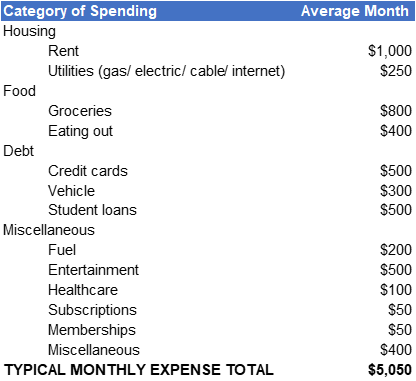
This example would say a typical month would be around five thousand cash going out the door. So, if your take home pay is above that number, that’s good right? It’s a good start, but it still might not be enough to meet your financial objectives. Maybe you want to get out from under that mountain of credit card debt, or maybe you want to save for a house.
Remember there’s two sides of that equation, Cash In > Cash Out. Let’s say you want to aim big and bring your cash out down to $4,000 a month. You’ve got a good map of where it’s easiest to cut. Take a look at those subscriptions you don’t use anymore. Maybe you’re willing to cook more and cut down on eating out. Some categories are much harder to reduce like rent and loans, others are easier. Find what works for you.
Budgeting doesn’t have to be painful even when you cut costs, it’s important to reward yourself. Set a short-term budget goal. If you meet your goal that month, splurge a little. Maybe what you’re saving for is reward enough, but budgeting is a long-term game. Make sure you enjoy the small wins.
Now for the cash in. Tally all your monthly sources of income. Most of the time that’ll just be our paychecks, but if you’re earning dividends, interest, or other sources of income, whatever hits your bank account and is reliable, include it. Make sure to only include the take-home amount. If your job is hourly or it varies week to week, I recommend making a conservative estimate based on your recent but worst weeks of pay.
Again, having take-home pay greater than your expenses is a good start, but if your income is below, and you can’t seem to shed costs like you want, then you should consider raising your income. Getting a side gig, asking for a raise, or getting a new job is all on the table. There’s a saying, “if you’re not making money, you’re spending it”… getting a side job will not only add a bit of extra money to your bank account, but it often means you’re too busy to be spending on things like entertainment and eating out, lowering your monthly spend.
If part of your income is being saved for retirement, like a 401k, it’s deducted from your paycheck meaning your take-home pay is less. Saving for retirement is excellent, but make sure you’re liquid enough to make it there! Temporarily reducing those deductions from your paycheck are another way to get on track with your budget.
Advanced Budgeting
Some things don’t fit neatly into your personal budget when tracked at a monthly level. Car insurance paid annually, or a year-end bonus. Here’s where your bank balance comes into play. If there’s a big payment, maybe you want to pay off a credit card entirely, make sure your coffers are full enough to take the hit. There’s a rule of thumb, keeping a bank balance (or cash) of two months’ worth of expenses is a good safety net. If you can’t get there, aim for one. When that big cost comes up, you’re ready for it.